Evaluating Bigland Retro for Urban Logotype Projects
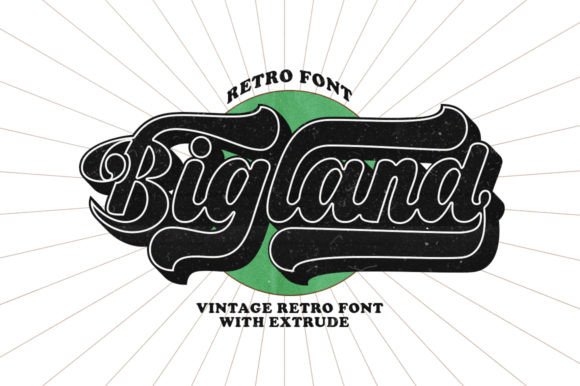
Selecting the right typeface is a critical step in establishing a brand's visual identity. For designers and business owners seeking an aesthetic that bridges modern urban culture with nostalgic charm, Bigland Retro presents a compelling option. This font is categorized as an urban retro typeface, specifically engineered to function as logotype lettering. Its design language draws from mid-century signage and street art, offering a distinct personality that can define a project's tone before a single image is viewed. Understanding the specific characteristics, technical capabilities, and ideal use cases of this font is essential for determining if it aligns with your creative goals.
Defining the Aesthetic and Style
At its core, Bigland Retro is designed to evoke a sense of timelessness while remaining firmly rooted in contemporary design trends. The style mimics hand-drawn logotype lettering, characterized by bold strokes, rounded terminals, and a slightly irregular baseline that suggests human craftsmanship rather than mechanical precision. This "urban retro" classification implies a fusion of gritty city vibes with the polished look of vintage advertising.
The font's structure supports high legibility even at larger sizes, making it particularly effective for headlines and branding elements. Unlike standard sans-serif or serif fonts that prioritize neutrality, Bigland Retro injects immediate character into text. It carries a weight that feels substantial without being cumbersome, allowing it to stand out against complex backgrounds or minimalist layouts alike. For projects aiming to communicate authenticity, heritage, or a cool, laid-back atmosphere, this stylistic approach offers a strong foundation.
Technical Capabilities and PUA Encoding
Beyond its visual appeal, the technical construction of Bigland Retro plays a significant role in its utility for professional designers. A key feature of this typeface is its PUA (Private Use Area) encoding. In the context of typography, PUA encoding allows font developers to map special characters, glyphs, and swashes to specific code points within the font file that are not part of the standard Unicode set.
For the end-user, this translates to seamless access to a wide array of decorative elements. Without PUA encoding, accessing alternate letterforms or ornate swashes often requires navigating complex OpenType panels or using specific software shortcuts that may not be universally supported across all design applications. With Bigland Retro's PUA implementation, users can typically access these unique glyphs directly through their character map or by typing specific keystrokes, depending on the operating system. This ease of access encourages experimentation, allowing designers to quickly iterate on logo variations and custom lettering arrangements without technical friction.
Benefits of Swashes and Glyphs
- Versatility: The inclusion of multiple swashes allows a single font file to generate numerous unique logo lockups, reducing the need for custom vector drawing.
- Efficiency: Designers can rapidly prototype different looks by swapping standard characters for decorative alternates.
- Uniqueness: Access to a full glyph set ensures that the final logotype can be distinct, avoiding the generic look of unmodified stock fonts.
Ideal Use Cases and Strategic Fit
Determining whether Bigland Retro is the right choice involves matching its personality to the project's requirements. This font excels in scenarios where the brand identity needs to feel approachable yet established. It is a strong fit for industries such as craft breweries, coffee shops, barber shops, streetwear clothing lines, and artisanal food packaging. In these sectors, the "urban retro" vibe resonates with target audiences who value tradition and manual quality.
Furthermore, because it is styled like logotype lettering, Bigland Retro is best utilized for short-form text. It shines in main logos, product labels, t-shirt graphics, and poster headlines. Its bold nature commands attention, making it effective for merchandise where the typography serves as the primary visual element. When used in these contexts, the font helps create an emotional connection, suggesting that the brand has a story and a history, even if it is a new venture.
Considerations and Potential Tradeoffs
While Bigland Retro offers significant advantages for specific applications, it is not a universal solution. Designers must evaluate potential limitations before committing to it for a comprehensive branding suite. The most notable tradeoff is readability in long-form text. The decorative nature and varying stroke widths that make it excellent for logos can cause eye fatigue when used in paragraphs, brochures, or website body copy. For these purposes, pairing Bigland Retro with a clean, neutral sans-serif or a highly legible serif font is advisable to maintain hierarchy and readability.
Additionally, the distinct personality of the font can sometimes overpower other design elements. If a project requires a subtle, background presence or a highly corporate, conservative tone, Bigland Retro may be too expressive. Its urban edge might clash with brands aiming for luxury minimalism or high-tech futurism. In such cases, alternatives with more restrained geometry or traditional serif structures may be worth considering.
When to Consider Alternatives
- Corporate Environments: If the brand voice needs to be strictly formal, authoritative, or invisible, a standard grotesque or humanist sans-serif is likely a safer choice.
- Small Sizes: For UI elements, footnotes, or mobile app interfaces where space is limited, the intricate details and swashes of Bigland Retro may not render clearly.
- Global Accessibility: While PUA encoding is powerful, it can sometimes present challenges in web environments if not implemented with proper CSS or webfont standards, potentially affecting cross-browser consistency compared to standard Unicode fonts.
Making the Final Decision
Ultimately, the decision to integrate Bigland Retro into a project should rest on the specific narrative the brand wishes to tell. If the goal is to create a memorable, character-driven identity that leverages the popularity of vintage aesthetics while maintaining a modern edge, this font is a robust candidate. Its PUA encoding adds a layer of practical value, empowering designers to customize the lettering extensively without needing advanced illustration skills.
However, successful implementation requires restraint and strategic pairing. By reserving Bigland Retro for display purposes and supporting it with functional secondary typefaces, designers can maximize its impact while mitigating readability concerns. Evaluating the font against the brand's long-term vision ensures that the choice contributes to a cohesive and enduring visual identity. Whether for a new startup looking to establish credibility through style or an existing business seeking a refresh, Bigland Retro offers a specialized toolset that, when used confidently and appropriately, can yield exceptional results.