Evaluating Repad Stencil for Laser Cutting and Industrial Design Projects
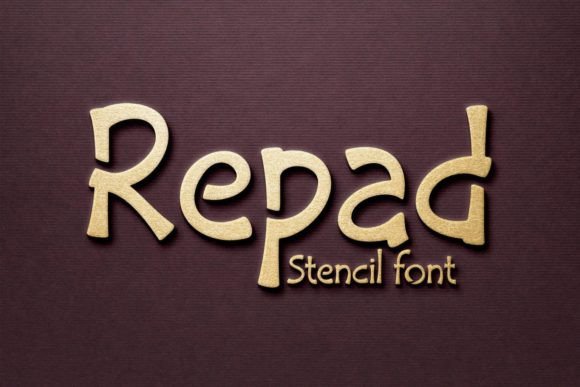
When selecting typography for physical fabrication, the transition from screen to material introduces a unique set of constraints that digital design often overlooks. Repad Stencil emerges as a specialized solution in this landscape, designed specifically to bridge the gap between aesthetic appeal and mechanical feasibility. Unlike standard display fonts intended solely for print or web use, this typeface is engineered with the limitations of laser cutters, CNC routers, and vinyl plotters in mind. Its defining characteristic is the complete absence of closed loops within the character forms, a structural decision that fundamentally alters how the font performs during the manufacturing process.
For designers and makers aged 20 to 50 who frequently navigate the complexities of prototyping and production, understanding the nuance between a visually similar font and a functionally optimized one is critical. Repad Stencil offers a fun and quirky aesthetic, but its primary value proposition lies in its utility. By eliminating islands—those detached parts of letters like the center of an "O" or the dot of an "i"—the font ensures that every character remains a single, contiguous piece of material. This eliminates the need for manual bridging, taping, or complex assembly after cutting, streamlining the workflow significantly.
The Mechanics of Loop-Free Typography
To appreciate why Repad Stencil is distinct, one must first understand the mechanics of subtractive manufacturing. When a laser cutter or plotter processes a standard font, it follows the vector paths defined by the designer. In traditional typography, many characters contain enclosed spaces. If you cut these out of a sheet of wood, acrylic, or metal, the inner pieces fall out immediately, leaving a hole rather than a letter. To prevent this, designers typically have to manually add "bridges" or "ties" to connect the inner islands to the outer shape. This process is time-consuming and can compromise the visual integrity of the typeface if not executed with precision.
Repad Stencil bypasses this issue entirely through its construction. Every glyph is drawn as a continuous line or shape without internal voids. This means that when the machine finishes its job, the text is ready to apply or install immediately. There are no loose parts to retrieve from the waste bin and no fragile connections to reinforce. This approach is particularly valuable for users who prioritize efficiency and repeatability. Whether you are producing signage for a retail environment, creating custom branding for packaging, or fabricating decorative elements for an event, the reliability of the output is paramount.
Comparing Functional Stencils to Decorative Alternatives
In the broader ecosystem of display fonts, there is often a tension between style and substance. Many quirky or handwritten fonts offer excellent personality but fail miserably when subjected to physical cutting tools. Conversely, industrial stencils designed for military crates or shipping containers often lack the warmth and creativity required for modern branding or artistic projects. Repad Stencil occupies a middle ground, offering a playful demeanor while maintaining rigorous functional standards.
When evaluating alternatives, consider the following factors:
- Structural Integrity: Standard decorative fonts may require significant vector editing to become cuttable. Repad Stencil arrives ready for production, reducing pre-press time.
- Aesthetic Flexibility: While some purely functional stencils appear rigid and utilitarian, Repad Stencil retains a hand-crafted feel, making it suitable for consumer-facing applications where cold industrial looks are undesirable.
- Material Versatility: Because the design relies on continuous paths, it performs consistently across various media, from thin vinyl decals to thick plywood sheets, without the risk of delicate interior pieces shifting or breaking.
It is important to note that not every project requires a loop-free font. If your final output is strictly digital, such as a website header or a social media graphic, the specific engineering of Repad Stencil offers no inherent advantage over other display options. In those contexts, the choice becomes purely about visual preference. However, for anyone whose workflow involves moving pixels into the physical world, the distinction is substantial.
Practical Applications and Best-Fit Scenarios
The utility of Repad Stencil extends across several industries and hobbyist pursuits. For small business owners creating their own signage, the font reduces the barrier to entry. You do not need advanced vector editing skills to prepare the files; the font file itself handles the heavy lifting. This is equally true for educators teaching fabrication techniques. Students can focus on design composition and machine operation rather than getting bogged down in the tedious process of fixing broken letterforms.
Consider a scenario involving a custom wedding invitation suite that includes laser-cut wooden place cards. Using a traditional serif font would result in dozens of tiny, lost centers for letters like "A," "B," "D," "O," "P," "Q," and "R." Assembling these would be a nightmare. With Repad Stencil, the place cards are cut and finished in a single pass. Similarly, for makers creating layered paper art or vinyl decals for vehicles, the continuity of the strokes ensures that the design holds together without additional adhesive points or strategic placement of bridges.
However, there are tradeoffs to consider. The absence of closed loops inevitably changes the silhouette of the characters. Some purists might argue that this alters the traditional recognition of certain glyphs. While Repad Stencil is designed to remain highly legible, the stylistic compromise is visible. If a project demands strict adherence to classical typographic proportions or a specific historical style that relies on enclosed counters, this font may not be the appropriate tool. It is a stylistic choice as much as a technical one.
Decision Factors for Selecting the Right Resource
Choosing the right typography resource requires a clear assessment of your project goals. If speed of production and material efficiency are your primary drivers, Repad Stencil is a strong contender. It minimizes waste and maximizes throughput. On the other hand, if your project allows for post-processing assembly or if the design will never leave the digital realm, you have a wider array of options available to you.
When comparing resources, look beyond the preview images. Examine the vector paths. Does the font require you to weld shapes together? Are there hidden overlaps that might confuse your cutting software? A well-constructed stencil font like Repad Stencil should provide clean, unified paths. This level of quality control is essential for professional results. Poorly constructed fonts can lead to machine errors, double-cutting lines, or jagged edges that ruin the finish of high-end materials.
Furthermore, consider the scale of your application. At very small sizes, the breaks inherent in stencil designs (even loop-free ones) can sometimes impact readability if the stroke width is too thin relative to the gaps. Repad Stencil generally maintains robust stroke weights, but testing at your intended size is always recommended before committing to a full production run. This due diligence ensures that the "quirky" nature of the font enhances rather than detracts from the message.
Balancing Aesthetics with Engineering Constraints
The intersection of art and engineering is where tools like Repad Stencil shine. They represent a shift in thinking where the medium dictates the form. Instead of forcing a digital concept onto a physical machine and struggling with the fallout, this approach embraces the machine's logic from the outset. This mindset is increasingly relevant in an era where desktop fabrication is accessible to a broad audience.
For the pragmatic designer, the value lies in predictability. Knowing exactly how a font will behave when the laser fires allows for more confident creative decisions. You can experiment with layout and composition without fearing that the production phase will introduce unforeseen complications. This reliability fosters creativity rather than stifling it, as the technical hurdles are lowered.
Ultimately, the decision to use Repad Stencil or a similar alternative comes down to the specific requirements of your workflow. If you are frequently engaging with lasers, engravers, or plotters, having a library of loop-free, single-path fonts is an investment in efficiency. It transforms a potentially frustrating assembly task into a seamless production step. While it may not replace your entire type collection, it serves as an indispensable specialist tool for projects where physical durability and ease of fabrication are non-negotiable. By understanding these nuances, you can select resources that not only look good on the screen but perform flawlessly in the real world.